Money Laundering
Overview
- A hidden contact offers laundering contracts without an item, job, or police-online requirement.
- Contracts clean metadata-bearing
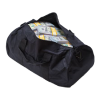 black_money
 - A supplied vehicle costs a $500 cash deposit, but only $250 is returned with the vehicle.
- Level 7 replaces contracts with a private washing and counting warehouse.
Access
- Start contact —
-802.26, -892.38, 20.86; no map blip. - Contract vehicle spawn —
125.9180, 278.1013, 110.9004; the supplied model is eitherballer3orfugitive. - Contract customers are selected from 30 handoff points across Los Santos.
- Level 7 warehouse — enter at
1142.6859, -986.6674, 45.9059; the warehouse key warehouse_key
Usage
Contracts
- Start a contract and accept the customer's cleaning amount, or negotiate for the level's larger offer.
- Collect the supplied vehicle, follow the marked contract, and hand over the requested
- A rejected offer does not end the run. Complete more contracts to gain laundering XP.
- Return the vehicle to recover $250 of the $500 deposit.
Warehouse
- At level 7, load $500-$750,000 into the washing machine.
- Wait 1 minute for the cycle and collect the uncounted output.
- Count up to $15,000 per sitting; each $10,000 plays one counting cycle.
- Counted money pays to cash.
lb-phonesends the ready notification.
Progression
Each level requires another 100,000 XP.
| Level | Tax | Contract size | XP | Negotiation | Rejection |
|---|---|---|---|---|---|
| 1 | 25% | $500-$1,000 | 1,000 | 60% / +25% | 20% |
| 2 | 20% | $750-$1,500 | 500 | 70% / +50% | 15% |
| 3 | 15% | $1,000-$2,000 | 250 | 80% / +75% | 10% |
| 4 | 10% | $1,500-$3,000 | 125 | 90% / +100% | 5% |
| 5 | 5% | $2,000-$10,000 | 85 | 95% / +125% | 3% |
| 6 | 3% | $6,000-$16,000 | 85 | 97% / +150% | 0% |
| 7 | 0% | $8,000-$18,000 | 90 | 99% / +175% | 0% |
Unavailable routes
- Police dispatch on rejected contracts is disabled, so rejections never create a police report.
- Contract work is disabled after level 7; level-7 players use the warehouse route instead.
Bugs
- Warehouse output uses an unregistered item key: the washer points at
cash, while the countable inventory item is uncounted_money
 - Dirty Money formats do not match: laundering expects each